The question that changes the visit: how did the pattern get there?
A beautiful fabric can be easy to admire and surprisingly difficult to describe. Was its colour applied to the surface? Was the pattern built into the weave? Were decorative threads added afterwards? Take those three questions into the National Textile Museum, near Dataran Merdeka on Jalan Sultan Hishamuddin. You do not need to become a textile expert. The pleasure is in noticing that two pieces which look equally elaborate from a distance may have been made in very different ways. This guide offers an independent way of looking, not a claim that we handled or tested the collection.
Batik: look for a pattern made through colour and resistance
Batik uses wax to resist dye, helping create patterns on cloth. Start by looking at the boundary between colours: a line can organise the whole design without being a raised thread. Then read the label for the particular object's method and origin. Do not try to authenticate a piece simply from how neat or irregular a line appears. A gallery visit is a good place to learn what a technique means; it is not a shortcut to deciding that every souvenir with a floral print must be hand-drawn batik.
Songket: a shimmer that belongs to the weaving
Songket is associated with decorative supplementary threads, often metallic gold or silver in appearance, woven into the textile. That makes it different from treating every shiny motif as embroidery. From the permitted viewing position, notice how the motif relates to the surrounding cloth: does it repeat across a field or gather at a border? Follow the exhibit's explanation rather than assuming shine tells you the metal's purity, the price or the time taken to make it. The interesting discovery is the relationship between structure and decoration, not a guessed luxury ranking.
Embroidery: decoration added with a needle
Embroidery works decoration into an existing ground with stitches. Comparing it with weaving gives you a useful distinction even when you cannot inspect the back of an object. Read the technique named on the label, then look at how a line, filled shape or edging is built up. Never touch a display to test its texture. If a detail is too small to identify through glass, leaving it as a question is better than inventing an explanation. You can enjoy the craftsmanship without assigning every glittering surface to one technique.
Use the four gallery names as clues, not a race route
The museum's official introduction describes four galleries. Pohon Budi introduces textile history and techniques; Pelangi explores varied cultural traditions; Teluk Berantai focuses on the richness of Malay textile craft; Ratna Sari brings jewellery and adornment into the story. Use that outline to choose what interests you, while following the actual visitor route and current displays. If the first rooms make you curious about a technique, give it time. There is no need to turn four gallery names into four hurried photographs.
Then look at how an outfit comes together
A textile does not have to tell its story alone. Where the displays and labels allow, consider what a border, fastening or piece of jewellery adds to the overall dress. A detail can direct the eye towards an edge, frame the face or change the balance of a silhouette. Those are visual observations, not permission to guess the wearer's status, religion or ceremonial role. Read the interpretation for those meanings. With a companion, each choose one detail you would otherwise have missed, then explain why it caught your eye.
A compact cultural idea for a KL day
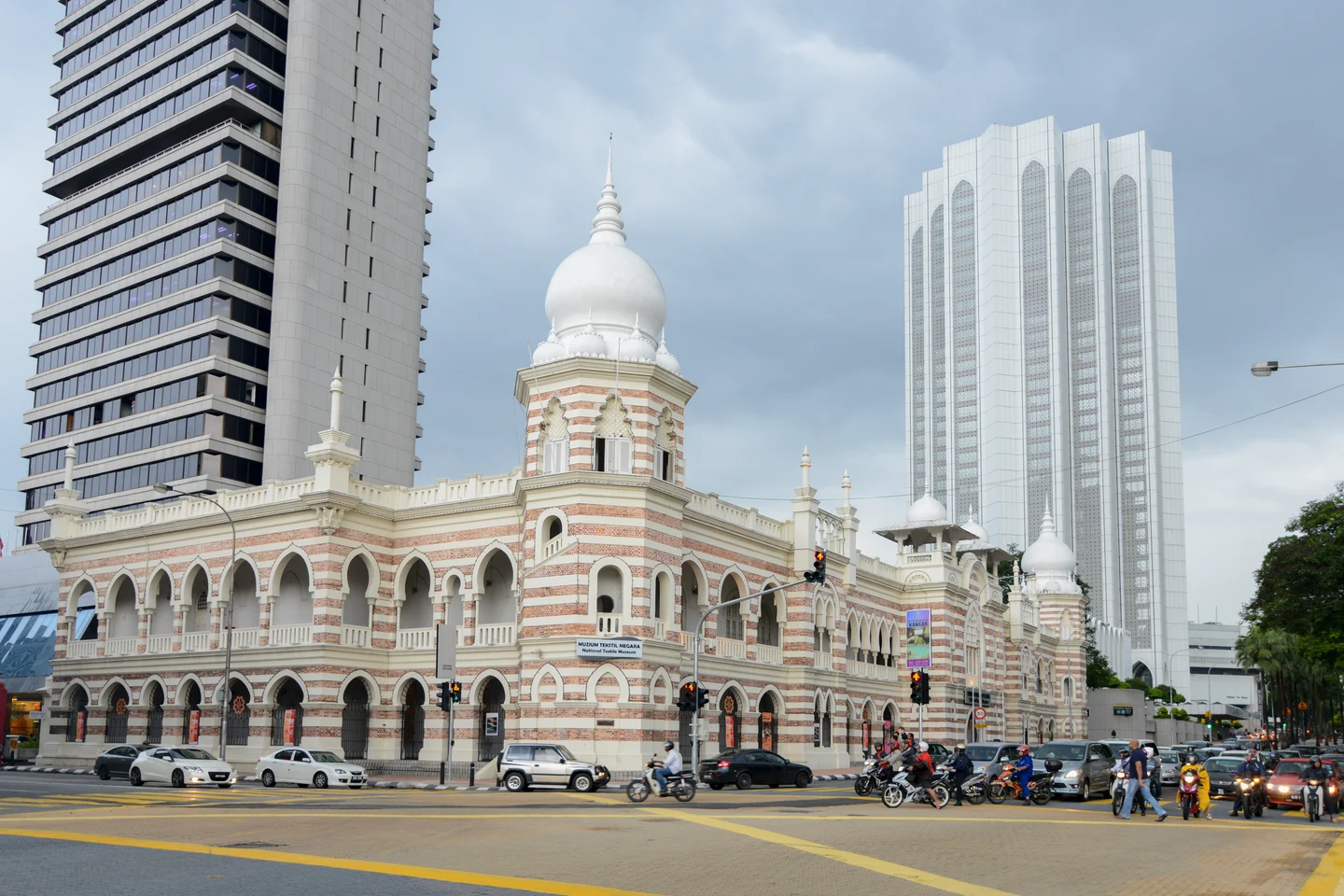
This is a different outing from browsing a fashion mall or attending a craft workshop. You are looking at the making and use of textiles, not being promised a shopping session, a demonstration or a class. The historic exterior in our photograph helps identify the setting, but it was taken in 2014 and cannot confirm today's entrance arrangements. Check the museum's current opening, admission and exhibition notices before leaving; ask directly about step-free access, seating or assistance your group needs. Nearby landmarks have their own access conditions, so choose any additional stop separately.
Let the transport fit the visit, rather than dominate it
For a Singapore–KL enquiry, share your travel dates, exact pickup and hotel or final destination, passenger and luggage details, child or mobility needs and return plan. Add requested stops or waiting so vehicle fit and the quote can be confirmed. A museum visit, admission, meals and local touring are separate unless agreed. Checkpoint queues, traffic and rest stops make long-distance arrival uncertain; avoid tying a fixed visit to a guaranteed crossing time. Museum and tourism sources were checked on 6 October 2026. This is an independent cultural guide, not an official museum package or a claimed personal review.
Sources and image credit

Article FAQ
Is songket simply gold embroidery?
No. Songket's decorative supplementary threads are part of the weaving process; embroidery adds stitched decoration to a ground. Read each object's label for its specific technique.
Is this a hands-on batik workshop?
No workshop is promised here. The guide is about viewing and understanding museum displays. Any separately advertised activity needs its own current confirmation.
Is the photograph of the current exhibition?
No. It is a credited exterior photograph from 2014. Current exhibits, entry, hours and admission should be checked with the museum.