Begin with curiosity, not a timetable
If your Kuala Lumpur plans already include a mall, a skyline photograph and dinner, an afternoon at Islamic Arts Museum Malaysia offers a different rhythm. Its official gallery guide lists twelve permanent galleries over two gallery floors. That is an invitation to choose, not a challenge to finish everything. Our five approaches below are editorial suggestions for an interested first visit. You can follow the one that appeals most, pause over a single object and leave without feeling that an unseen cabinet means you did the museum incorrectly.
1. Travel through buildings in miniature
The Architecture Gallery uses scale models to bring distant buildings into the same room, including the Taj Mahal and the Great Mosque of Xi'an. Look first at their overall shapes, then at how an entrance, roof or courtyard organises the building. You need not label a style correctly to notice that the examples do not all look alike. A model also lets you see a building as a whole, something that can be difficult when standing beside a full-size wall. Pick two contrasting silhouettes and ask what gives each its character.
2. Follow one colour or repeating shape
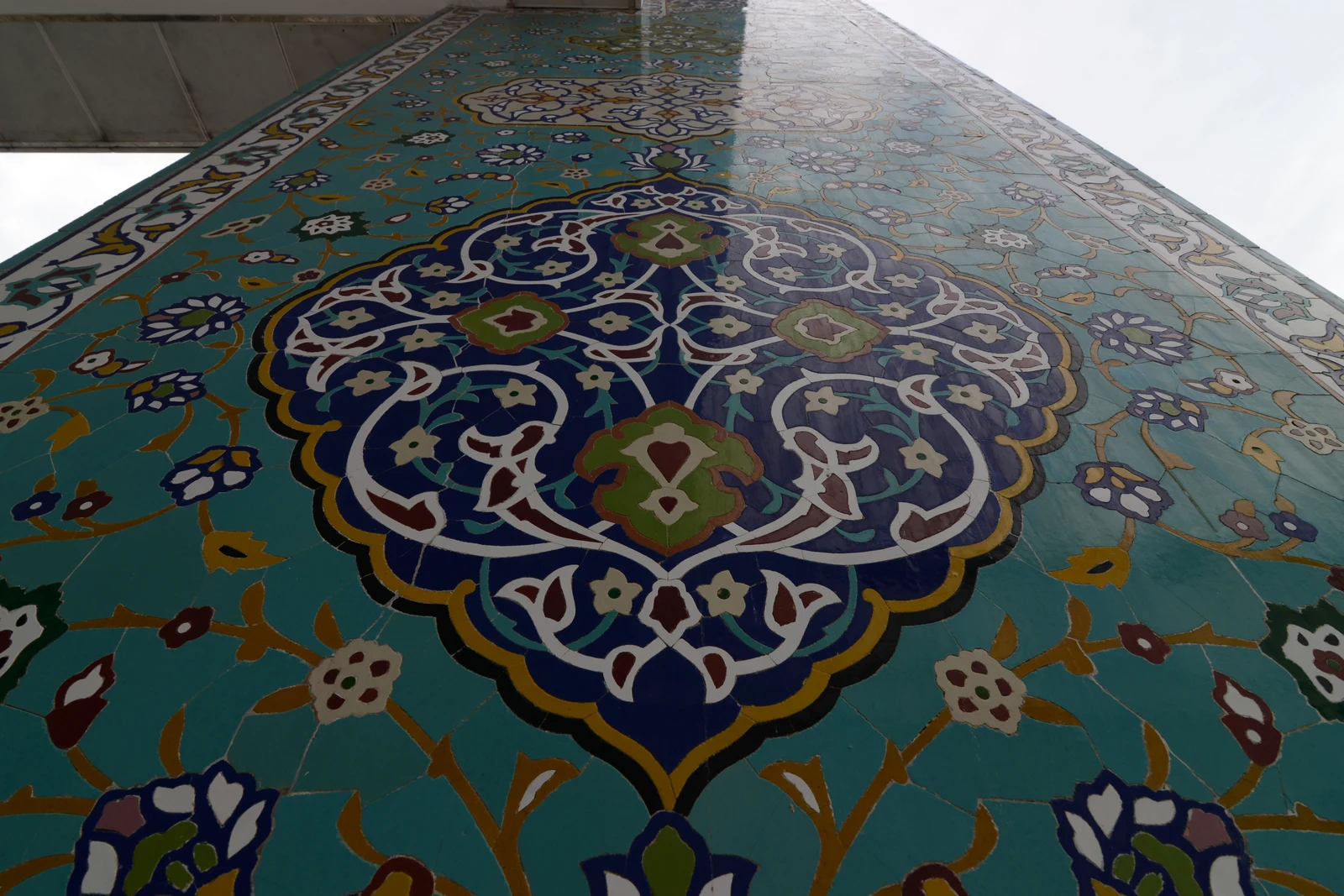
The museum's tiled exterior offers a useful starting point: choose a blue, a curve or a flower-like form before you enter the galleries. The image above shows that exterior in 2014, not a promise about today's displays. Inside, use the same looking game wherever a relevant object catches your eye. Does repetition make a small surface feel larger? Does a border contain the pattern or interrupt it? This is an observation exercise, not a claim that the facade and every decorated object share the same origin, meaning or technique. Read labels before making those connections.
3. Let an ordinary bowl open a wider story
In the Ceramics Gallery, an everyday object type becomes a way of noticing exchange between cultures. The museum's account discusses Chinese influences alongside distinctive regional approaches within Islamic ceramics. Instead of reducing that history to 'one place copied another', compare form, surface and decoration, then read the interpretation beside the object. A bowl has an inside and an outside: which surface attracts attention first? Looking carefully at something familiar can be more rewarding than rushing towards the biggest or most elaborate piece.
4. Imagine a room being used, not only displayed
The Architecture Gallery also presents the Ottoman Room, associated with Damascus and dated 1820–1821. Its painted interior shifts the scale of the visit from whole buildings to a space made for receiving people. Stand where visitors are permitted and look at how decoration surrounds the room rather than behaving like one framed picture. Then ask what kind of atmosphere it creates. Do not assume you may enter, touch or photograph every part: follow the current gallery instructions. The point is to consider a lived setting, not to treat historic decoration as a backdrop for a staged pose.
5. Make your own two-object conversation
After one or two galleries, choose a pair of objects that seem to speak to each other. They might share a colour but differ in material, or solve a similar decorative problem in very different ways. Read their dates and places rather than guessing a relationship. If the labels show they are far apart in time or geography, that difference is part of the interest. With children, each person can choose a favourite detail and explain the choice. There is no need to turn the afternoon into a quiz, and no prize for selecting the most famous object.
Build a museum afternoon, not a race across KL
Leave some uncommitted time after the galleries for a break, a second look or a conversation about what you noticed. The museum lists MOZA Restaurant at ground level, but check its current service hours and menu rather than assuming a meal is included with admission. Nearby attractions are separate visits with their own access and dress requirements; proximity on a map is not a timed walking itinerary. If your group wants a calm indoor cultural stop, give that experience space instead of automatically adding three more landmarks.
Useful details before you go
The official visitor page, checked on 1 October 2026, lists normal opening from 9:30am to 6pm, with different Ramadan closing and Eid holiday arrangements. Check current notices and ticket information before travelling. Its accessibility information describes a step-free front entrance on Jalan Lembah Perdana, lifts and seating; ask about your particular route or assistance needs rather than assuming every part of the outing is equally accessible. A historical facade photograph and a general visitor page cannot establish which individual display, entrance or facility will be available on a future date.
Keep the intercity transfer separate from museum admission
For Singapore-to-KL transport, provide the exact pickup and KL hotel or destination, travel date, passengers, luggage and any child or mobility needs. Include the return journey, stops and extra waiting you want quoted. The operator must confirm vehicle fit and the arrangement; museum admission, meals and local sightseeing are not automatically part of an intercity transfer. Border queues, highway traffic, weather and rest breaks make arrival uncertain, so do not hinge a fixed museum booking on a guaranteed crossing time. This independent guide is based on museum information, not a claimed personal visit or museum partnership.
Sources and image credit

Article FAQ
Do I need to know Islamic art before visiting?
No. Start with shape, colour and materials, then use the museum labels to understand the object. The five approaches are looking prompts, not an academic syllabus.
Must I see all twelve permanent galleries?
No. Choose a few interests and leave time to look closely. Gallery access and displays should still be checked with the museum.
Is this an official guided tour or included transport package?
Neither. It is an independent editorial guide. Admission, guiding, local travel and meals require their own confirmation.